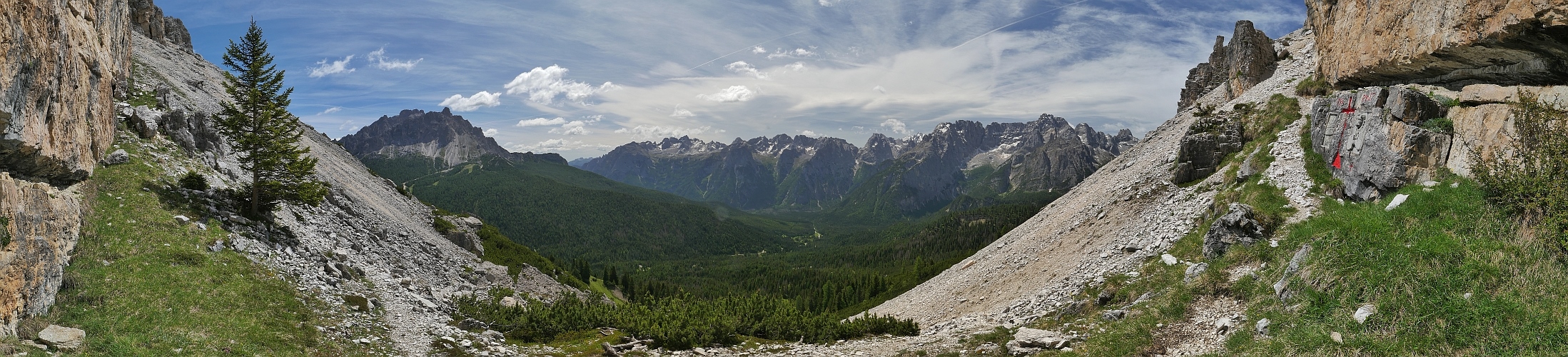
The image shows historical boundary markers and relief sculptures on the famous Muraglia di Giau (Giau Wall) in the Italian Dolomites.Details of the markers the red line and the cross:
These are historical boundary marks that have been traced over with conspicuous red signal paint. Directly above or next to the cross, the year of the border demarcation is traditionally carved.
The reliefs: The stone plaques embedded in the rock show heraldic symbols of the conflicting parties of that time. Visible among others are the Venetian Lion of Saint Mark (symbol of the Republic of Venice) on one side and the coat of arms of the house of Austria (for the Habsburg Monarchy) on the other side.
Greetings
All correct except for one detail: we are not in the Giau Pass area but between Mount Cristallo and Misurina. This in particular is the very well preserved boundary stone no. 17 belonging to the old border between Ampezzo — part of the Austro-Hungarian Empire — and Auronzo, a territory of the Venetian Republic like the entire Cadore. Until 1915 it also marked the State border between Italy and the Empire. This border segment was defined in 1753 with the "treaty of Rovereto" by appointment between Mary Therese of Austria and the Doge of Venice, and it's described as follows in the documents of the Treaty: "per una
parte di Mesurina ed altre montagne con li boschi goduti tra esse in comunione, cioè Maraja, Ansejo, Campedello, Col S. Angelo e Valbona”. The boundary stone no. 17 is described as follows: "Main boundary, number 17, letter P in Cengio with coat of arms and year."
As a Venetian, I'm always deeply struck by these ancient testimonies to the presence of the Serenissima in our mountains. The winged Lion still roars, after 260 years.
Comments
These are historical boundary marks that have been traced over with conspicuous red signal paint. Directly above or next to the cross, the year of the border demarcation is traditionally carved.
The reliefs: The stone plaques embedded in the rock show heraldic symbols of the conflicting parties of that time. Visible among others are the Venetian Lion of Saint Mark (symbol of the Republic of Venice) on one side and the coat of arms of the house of Austria (for the Habsburg Monarchy) on the other side.
Greetings
parte di Mesurina ed altre montagne con li boschi goduti tra esse in comunione, cioè Maraja, Ansejo, Campedello, Col S. Angelo e Valbona”. The boundary stone no. 17 is described as follows: "Main boundary, number 17, letter P in Cengio with coat of arms and year."
As a Venetian, I'm always deeply struck by these ancient testimonies to the presence of the Serenissima in our mountains. The winged Lion still roars, after 260 years.
Leave a comment